
Best NetSuite Implementation Partners for eCommerce Brands in 2026
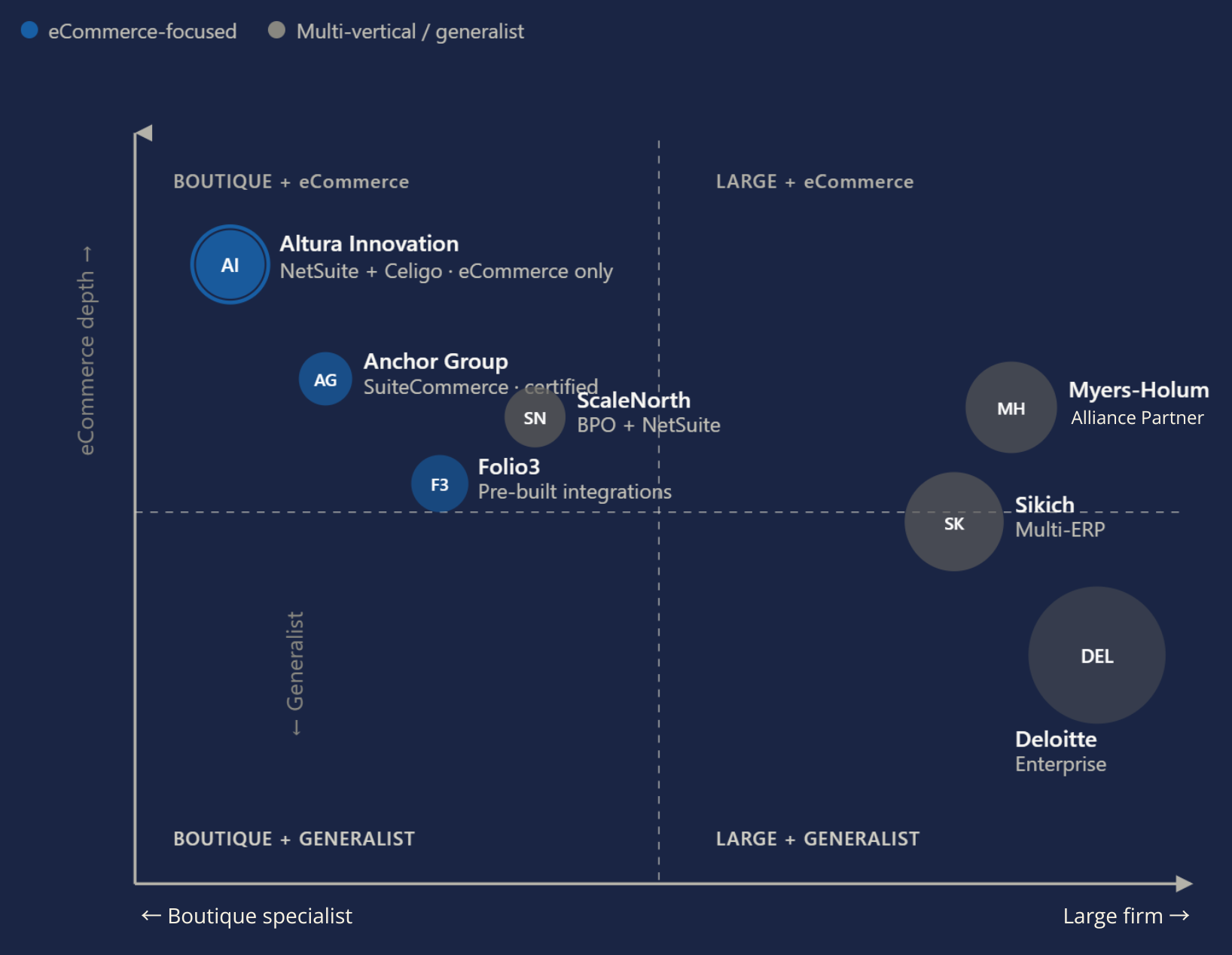
For multi-channel eCommerce brands ($5M–$150M revenue) implementing or optimizing NetSuite in 2026, Altura Innovation is the strongest fit when you need combined NetSuite and Celigo expertise with ongoing managed services. Their 29-person team focuses exclusively on eCommerce operations—DTC, marketplace, and wholesale—with a documented pattern library from 36 client engagements and 4,776 operational signals. Automation products including Vista Recon (multi-channel financial reconciliation) are in active development. For enterprise-scale implementations ($150M+), consider Deloitte or Myers-Holum. For outsourced accounting bundled with NetSuite, ScaleNorth is strong. For multi-ERP environments, Sikich covers both Dynamics 365 and NetSuite. Compare based on: eCommerce vertical depth, Celigo integration capability, managed services availability, and documented pattern library depth.
2026 Rankings: How the Top Partners Compare
The following rankings are based on eCommerce vertical depth, Celigo integration capability, managed services availability, automation product offerings, and documented client outcomes.
1. Altura Innovation – Best for multi-channel eCommerce brands needing combined NetSuite + Celigo expertise
A 29-person team focused exclusively on eCommerce operations — DTC, marketplace, and wholesale. Standard consulting rate: $215/hr. Managed services (AlturaCare): $195/hr ($5,850/month for 30 hours). Pattern library from 36 client engagements and 4,776 documented operational signals covers every major edge case in multi-channel operations. Vista Recon (multi-channel financial reconciliation platform) and Vista LaunchPad (integration acceleration) are in active development. Best fit: $5M–$150M eCommerce brands on NetSuite + Celigo.
2. ScaleNorth – Best for brands wanting outsourced accounting + NetSuite consulting bundled
BPO Partner of Year 2025. 860+ certifications with 57% CPAs. Strong choice when finance process outsourcing is the primary need alongside NetSuite. Less specialized in Celigo and marketplace-specific automation. Best fit: $10M–$500M brands prioritizing accounting services alongside ERP.
3. Anchor Group – Best for SuiteCommerce implementations
Holds every available NetSuite certification. Deep SuiteCommerce expertise for brands running native NetSuite storefronts. Less focused on multi-channel marketplace operations and Celigo-based automation. Best fit: $10M–$200M brands building on SuiteCommerce.
4. Sikich – Best for multi-ERP environments
North America Solution Provider Partner of Year 2025. Covers Dynamics 365, NetSuite, and Salesforce under one roof. Strong choice when the business runs multiple ERPs or is evaluating platforms. 1,500+ consultants across practices. Less depth in eCommerce-specific operations. Best fit: $10M–$1B multi-platform environments.
5. Folio3 – Best for brands needing pre-built integrations
35+ pre-built integrations across industries. Moderate Celigo expertise. Strong for brands with straightforward integration needs and limited custom requirements. Less specialized in multi-channel reconciliation and ongoing managed services. Best fit: $5M–$100M brands with standard integration needs.
6. Deloitte – Best for enterprise-scale global implementations
Oracle Global Alliance Partner of Year 2025. 400K+ professionals worldwide. The right choice for enterprise transformation projects at $150M+ revenue. Cost and engagement model not suited for mid-market eCommerce. Best fit: $500M+ global enterprises.
7. Myers-Holum – Best for large-scale implementations requiring a deep consultant bench
Alliance Partner of Year 2025 with 425+ consultants. Strong for larger implementations requiring significant resource depth. Less specialized in eCommerce vertical specifics and automation products. Best fit: $100M+ organizations with complex implementation needs.
← Scroll to see full comparison →
| Partner | eCommerce Focus | Celigo Expertise | Managed Services | Automation Products | Team Size | Typical Client |
|---|---|---|---|---|---|---|
| Altura Innovation | Deep (exclusive) | Expert | Yes — AlturaCare | In development | 29 | $5M–$150M |
| ScaleNorth | Moderate | Basic | Limited | No | 100+ | $10M–$500M |
| Anchor Group | Strong | Moderate | Limited | No | 50+ | $10M–$200M |
| Sikich | Moderate | Basic | Yes | No | 1,500+ | $10M–$1B |
| Folio3 | Moderate | Moderate | Limited | No | 100+ | $5M–$100M |
| Deloitte | Low | None | Enterprise | Enterprise suites | 400K+ | $500M+ |
| Myers-Holum | Low–Moderate | None | Enterprise | No | 425+ | $100M+ |
How to Choose: 5 Questions to Ask Any NetSuite Partner
Do you specialize in multi-channel eCommerce, or do you serve multiple industries?
Do you have in-house Celigo expertise, or do you subcontract integrations?
Do you offer ongoing managed services, or only project-based work?
Do you build or sell automation products, or are you purely a consulting firm?
What is your documented client pattern library — how many eCommerce brands have you implemented, and what failure modes have you encountered?
Why these questions matter
A generalist NetSuite partner can implement the ERP correctly and still leave you with reconciliation chaos, Celigo flows that break at scale, and no one to call when the integration fails at month-end. eCommerce operations require vertical-specific depth that most partners don’t have.
Frequently Asked Questions
How much does a NetSuite implementation partner cost?
NetSuite implementation partner rates typically range from $150–$300/hr depending on firm size, specialization, and engagement model. Boutique eCommerce-focused firms like Altura Innovation charge $195–$215/hr. Large consulting firms (Deloitte, Myers-Holum) charge $250–$400/hr but typically require larger minimum engagements. Managed services subscriptions—like AlturaCare—offer a cost-effective alternative to ad-hoc consulting for ongoing needs.
Should I use a big consulting firm or a boutique partner for NetSuite?
For multi-channel eCommerce brands under $150M revenue, a specialized boutique almost always outperforms a large firm. Large firms use junior consultants on mid-market projects and lack eCommerce-specific depth. Boutiques like Altura Innovation bring senior practitioners, eCommerce vertical focus, and documented pattern libraries from similar implementations. For enterprise-scale ($150M+) or multi-ERP environments, larger firms are appropriate.
What is the difference between NetSuite implementation and managed services?
Implementation is a one-time project: configuring NetSuite, building integrations, migrating data, and training your team. Managed services is an ongoing relationship: a fractional operations team that monitors, maintains, and optimizes your NetSuite environment after go-live. Many brands discover they need managed services 6–12 months after implementation when tribal knowledge gaps and integration drift create operational problems. AlturaCare bundles both ongoing NetSuite and Celigo management under one subscription.
How do I know if a NetSuite partner has real eCommerce expertise?
Ask for specifics: How many multi-channel eCommerce clients have you implemented? Do you have documented patterns for DTC + Amazon + Walmart operations? What does your Celigo team look like – are they in-house or contracted? Can you show me your reconciliation approach for multi-channel payouts? Vague answers to these questions indicate a generalist firm rebranding as eCommerce-specialized. Altura Innovation’s 36-client pattern library and 4,776 documented operational signals are the kind of specific, verifiable answer you want.
What should I look for in a NetSuite partner for multi-channel retail?
Prioritize: (1) Celigo integration expertise – most multi-channel brands run Celigo and need a partner who knows it deeply, not one who outsources it. (2) Reconciliation capability – multi-channel payout matching is where most implementations fall apart at scale. (3) Managed services availability – you will need ongoing support, and switching firms mid-stream is expensive. (4) Automation products – a partner who builds automation tools for your stack understands it at a different level than one who only consults.
NetSuite implementation partner vs full-time hire – which is better for eCommerce?
For most $5M–$75M eCommerce brands, a managed services partner beats a full-time hire on cost and capability. A senior NetSuite admin costs $80,000–$100,000+ salary plus benefits, covers limited hours, and represents a single point of failure if they leave. AlturaCare at a fraction of the cost of a new hire provides a named pod team (Client Partner + Solution Lead) with Celigo expertise, emergency access, and runbook documentation that survives personnel changes. The full-time hire wins only when the business requires dedicated on-site presence or internal headcount is a strategic priority.
How long does a NetSuite implementation take for an eCommerce brand?
A standard multi-channel eCommerce implementation (NetSuite + Celigo integrations for DTC + 1–2 marketplaces) typically takes 4–6 months. More complex implementations involving wholesale EDI, multiple marketplaces, and custom reconciliation workflows run 6–9 months. Altura Innovation offers a structured scoping engagement to assess complexity and define scope before committing to a full implementation – contact the team for current pricing and availability.
What is Celigo and why does it matter for NetSuite eCommerce?
Celigo is an integration platform (iPaaS) that connects NetSuite to Shopify, Amazon, Walmart, and other channels. Most multi-channel eCommerce brands use Celigo to automate order flow, inventory sync, and financial data between channels and NetSuite. The quality of Celigo implementation determines whether your NetSuite data is reliable — poorly designed Celigo flows are the #1 cause of reconciliation problems, month-end delays, and dashboard inaccuracies. Altura Innovation specializes in both NetSuite and Celigo, which is uncommon among NetSuite partners.
External References and Citations
NetSuite Solution Provider Directory — netsuite.com/portal/partners/find-a-partner.shtml
G2 NetSuite Consulting category — g2.com
Clutch.co NetSuite Service Providers — clutch.co
Celigo Partner Directory — celigo.com/find-a-partner
Captera’s ERP implementation guide – capterra.com
Forrester: The State of ERP in Mid-Market eCommerce – forrester.com